You’ve been running your books in QuickBooks Desktop for years. Now you want to work from anywhere, give your accountant easy access, or stop paying for upgrades. The move to QuickBooks Online is doable, and QuickBooks gives you a free-standing tool for it, but it isn’t a button you press and forget.
Some things carry over and some don’t. A few steps can’t be undone. And if you run payroll, the timing matters. This guide gives you the full process, in order, with a checklist you can follow before and after.
The Short Version
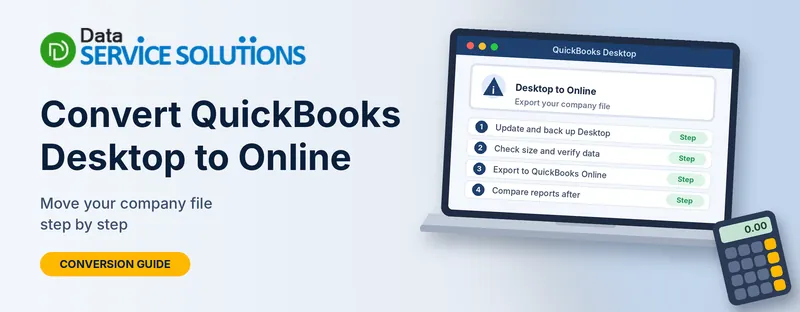
- Update, back up and tidy your Desktop file first.
- Check your file size, then verify and rebuild the data.
- Sign up for a QuickBooks Online plan, then export from Desktop or upload the file in a browser.
- Keep your Desktop file, then compare your reports in both products.
- Plan payroll and bank feeds separately. They don’t move with the file.
Should You Convert?
Converting makes sense if you want access from any device, easier sharing with your accountant, and no yearly version upgrades. Staying on Desktop can make sense if you rely on features that work differently online, or you have a very large file. QuickBooks Desktop isn’t going away for existing users, but QuickBooks stopped selling it to new U.S. subscribers after September 30, 2024 (Enterprise is excluded), and unsupported versions lose some services, including Desktop Payroll.
Not sure? Talk to your accountant before you start. The two products work differently, so it’s worth a short check.
What You Need Before You Start
| Requirement | What QuickBooks says |
|---|---|
| Desktop file version | Files from QuickBooks Desktop 2011 or newer work. For 2010 or older, update the file with File Doctor first. |
| Admin rights | You must be an admin in both the Desktop file and the QuickBooks Online company. |
| Country | Your QuickBooks Online account must be in the same country or region as your Desktop company. |
| Time window | You have 90 days from signing up for QuickBooks Online to move your data (180 days for an accountant doing it for you). |
| File size | Check Total Targets in Product Information. QuickBooks says to condense the file if it’s over the limit. |
| Mac | Moving from inside the Mac app needs QuickBooks Desktop for Mac 2020 or newer. |
| Hosted files | If a hosting company holds your file, ask for a copy first. |
Step 1: Prepare Your Desktop File
Spend an hour here and the move goes smoother.
- Update QuickBooks Desktop to the latest release. See how to update QuickBooks Desktop.
- Check your file size. Press F2 or Ctrl+1 and look at Total Targets. QuickBooks’ move page doesn’t print a number, and guides disagree on it (some say 750,000 for Pro and Premier and 1,200,000 for Enterprise, others say 350,000), so treat Total Targets as the figure to watch. If it’s large, condense the file or move only your lists and balances. See our guide on the QuickBooks Condense Data utility.
- Verify and rebuild your data. Go to File > Utilities > Verify Data. If it finds a problem, back up, then use Rebuild Data. Our QuickBooks File Doctor guide can help if problems persist.
- Clean up your lists. Merge or make inactive duplicate customers, vendors and items you no longer use. It’s easier to tidy them before the move than after.
- Categorize and reconcile your bank and credit card transactions. Bank feeds don’t move, so a clean register helps.
- Save these reports (as PDFs) so you can compare later: Profit and Loss, Balance Sheet, A/R and A/P aging, and the Sales Tax Liability report. Use the same dates you’ll check later.
- Keep the file on your computer. Move it off a network or hosted drive, and work in single-user mode.
- Back up your company file. See how to back up a QuickBooks Desktop company file.
- If you use QuickBooks Payments, make the person who’ll be your QuickBooks Online admin an admin on the account, so the Payments account moves with you.
- If you use QuickBooks Payroll, read the payroll section below before you do anything.
Step 2: Choose What to Bring
During the move, QuickBooks asks what to bring online:
- All company data: your lists and your full transaction history.
- Lists and balances only: customers, vendors, accounts, employees and items with current balances. This works well for a very large file or a fresh start.
If you use inventory, you’ll also be asked whether to track it in QuickBooks Online. This changes how your stock and costs are carried, so check with your accountant before you choose.
Step 3: Sign Up for QuickBooks Online
Choose a plan first (Simple Start, Essentials, Plus or Advanced). QuickBooks’ move page lists these, and lets you pick the plan that fits your business. QuickBooks’ move page doesn’t list a separate fee for the migration tool. Your cost is the QuickBooks Online plan and any add-ons such as payroll or payments, so check the current prices on QuickBooks’ site.
Starting the move from a brand-new QuickBooks Online company is the safest choice. You’ll see why in the warning below.
Step 4: Move the File (Pick One Way)
| Method | Use it when |
|---|---|
| Option 1: The tool inside Desktop | QuickBooks Desktop is installed on your computer |
| Option 2: The browser migration tool | You only have the file, or you’d rather work in a browser |
| Option 3: The Mac app tool | You use QuickBooks Desktop for Mac 2020 or newer |
Option 1: The Tool Inside QuickBooks Desktop
- Open your company file as an admin.
- Pro Plus or Premier Plus: go to Company > Move to QuickBooks Online > Export Your Company File to QuickBooks Online.
Enterprise: go to Company > Migrate to QuickBooks Online. If you don’t see it, press Ctrl+1, then Ctrl+B+Q, then click OK. - Click Get started and sign in with the account you use for QuickBooks Online.
- Choose Bring all of your company data or Bring only lists and balances, then Continue.
- Choose whether to track inventory, then Continue.
- Pick the QuickBooks Online company, then Continue.
- Work through the checklist. Fix each task, or click Complete All for the bulk ones, then Continue.
- On the Almost ready page, verify your file if you haven’t already, then Continue.
- If the online company already has data, you’ll be asked whether to replace it. Read the warning below.
- Click Continue, then Export.
Keep the window open until QuickBooks says it’s safe to close. You’ll get an email when your company is online.
Option 2: The Browser Migration Tool
- In QuickBooks Online, click Settings (the gear icon) and choose Import desktop data. Open the online migration tool and click Get Started.
- Click Select file and choose your company file (.QBW, .QBM or .QBB), or drag it into the box. For Enterprise, use the “switch to this link” option first.
- Wait for the upload. The tool updates the file to the latest Desktop version.
- Enter your Desktop admin credentials, then click Get Started.
- Follow the same prompts as Option 1, from choosing the data to Export.
You’ll get an email titled “Your company is now online” when it finishes.
Option 3: QuickBooks Desktop for Mac (2020 or Newer)
- Go to File > Export > To QuickBooks Online, or press Shift+Command+D. If you’re asked for a password, leave it blank.
- Click Get Started and choose Bring all your company file data or Bring only lists and balances.
- Sign in with your QuickBooks Online admin details, or create a new company.
- Pick the company and click Export. When you see “Company migrated successfully”, click Quit.
If you use an older Mac version, save a Windows backup (.QBB) and use Option 2.
Warning: Replacing Data Can’t Be Undone
If your QuickBooks Online company already has data, QuickBooks asks whether to replace it with the Desktop data. That choice is irreversible.
Unless you really want to overwrite what’s there, choose a new or different QuickBooks Online company. If you’re not sure, stop here and ask your accountant.
Step 5: Check Your New Company
When the “your company is online” email arrives, don’t start entering transactions yet. Check first.
- Run the same reports you saved, for the same date range, in both products: Profit and Loss, Balance Sheet, A/R aging and A/P aging.
- Compare your Sales Tax Liability report with the copy you saved.
- Spot-check a few customers, vendors and open invoices and bills.
If the numbers don’t match, look at the usual suspects: different report dates or basis (cash vs accrual), inventory, sales tax, and items that don’t transfer. Keep your Desktop file until everything agrees.
What Does and Doesn’t Transfer
Bank feeds don’t move, according to QuickBooks. The items below are commonly reported as not transferring, so check QuickBooks’ own “what transfers” list for your version before you rely on any of them.
| Usually moves | Usually doesn’t move |
|---|---|
| Customers, vendors, employees (as list records), accounts | Bank feeds and bank connections |
| Items and balances | Reconciliation reports (keep your Desktop file for these) |
| Transactions (with the “all data” option) | Audit trail |
| Sales tax data | Recurring credit card charges (rebuild them as recurring sales receipts) |
| Reports and report customization | |
| User roles and permissions | |
| Custom templates | |
| Inventory from QuickBooks for Mac (move it from a Windows file) | |
| Payroll data (see below) |
Payroll: Plan This First
If you use Desktop Payroll, the timing matters.
- Confirm your employee info is current, and make employees with no pay history this year inactive.
- Run payroll, then wait 2 to 3 business days before you move.
- Finish the move at least 7 business days before your next payroll date.
- After the move, set up payroll again. QuickBooks’ move page says Desktop Payroll data moves to QuickBooks Workforce, so set payroll up there before your next payroll date.
Don’t delete payroll records to get around an error. If you see a payroll error during the move, stop and get help. Our QuickBooks payroll support page explains how we can help.
After the Move: A Checklist
- Connect your bank accounts. See how to connect a bank account to QuickBooks Online.
- Invite your users and set their roles, because roles don’t carry over.
- Set up your templates for invoices and other forms.
- Rebuild recurring transactions that didn’t move.
- Check sales tax settings.
- Set up online payments. See how to set up QuickBooks ACH payments if you take bank payments.
- Reconnect third-party apps that used your Desktop file.
- Try the QuickBooks Online desktop app if you like Desktop’s layout. QuickBooks recommends it.
- Keep your Desktop file in a safe place. QuickBooks says you keep view-only access to your Desktop data for 12 months after you cancel your Desktop subscription, but keep your own backup too.
How Long Does It Take?
It depends on the size of your file. QuickBooks emails you when your company is online. Small files can finish quickly, and large ones can take hours, so don’t plan to start payroll the same day. Allow time for the checks, and expect to spend extra time on cleanup if your lists are messy.
Common Problems and Fixes
| What happens | What to try |
|---|---|
| The tool says your file is too large | Condense the file, or choose lists and balances only |
| The tool can’t read an older file | Update the file with File Doctor first (2010 or older) |
| The “Move to QuickBooks Online” option is missing in Enterprise | Press Ctrl+1, then Ctrl+B+Q, then click OK |
| Your online company doesn’t appear in the list | Check that you’re an admin and that the account is in the same country, then sign out and in again |
| Reports don’t match after the move | Check dates, basis, inventory and sales tax, then compare lists |
| The move fails or stalls | See our QuickBooks migration failed unexpectedly guide |
If you’re moving Desktop to a new computer instead, our QuickBooks migration tool guide covers that.
Mistakes to Avoid
- Replacing data in an online company you still need
- Skipping the backup and the saved reports
- Starting the move too close to a payroll date
- Moving a messy file without cleaning your lists
- Canceling Desktop before you’ve checked your data
- Assuming bank feeds, roles and templates will come across
When to Get Help
Get help if your file is very large, your inventory is complex, you run payroll, or the numbers don’t match after the move. A short review before you start costs far less than fixing a bad move. Our QuickBooks data migration service can go through your file with you, or you can contact us.
Frequently Asked Questions
Can I convert QuickBooks Desktop to QuickBooks Online?
Yes. QuickBooks provides a tool for it in Desktop, a browser upload tool, and a Mac option.
Will I lose any data?
Most of your lists and transactions move, but some things don’t, such as bank feeds, reconciliation reports and user roles. Keep your Desktop file and compare reports after the move.
How long do I have to convert?
QuickBooks says 90 days from signing up for QuickBooks Online, or 180 days if an accountant does it.
Which QuickBooks Desktop versions can I convert?
Files from Desktop 2011 or newer work. For 2010 or older, update the file with File Doctor first.
Is the conversion free?
QuickBooks’ move page doesn’t list a separate fee for the tool. You pay for the QuickBooks Online plan and any add-ons.
Can I undo the conversion?
You can’t undo replacing data in a QuickBooks Online company, so use a new company if you’re unsure. Your Desktop file stays available, so keep it.
What happens to my payroll?
Payroll doesn’t move with the file. Set it up again before your next payroll date, and finish the move at least 7 business days before it.
Can I use Desktop and Online together?
Not for the same books. Pick one as your main file to avoid double entry.
Do my bank feeds move?
No. You reconnect your accounts in QuickBooks Online.
What if my file is too big?
Condense it, or move lists and balances only. Check Total Targets in Product Information.
Can I convert from QuickBooks for Mac?
Yes, with Mac 2020 or newer from inside the app, or with a Windows backup (.QBB) through the browser tool.
Should I do the conversion myself or get help?
A small, clean file is a reasonable do-it-yourself job. For large files, inventory, payroll or mismatched numbers, get a second pair of eyes.
Wrapping Up
Converting QuickBooks Desktop to Online is mostly preparation: update, back up, clean up, move to a new company, then check your reports. Plan payroll and bank feeds separately, and keep your Desktop file until everything agrees. If you’d like a hand, the Data Service Solutions team can help.